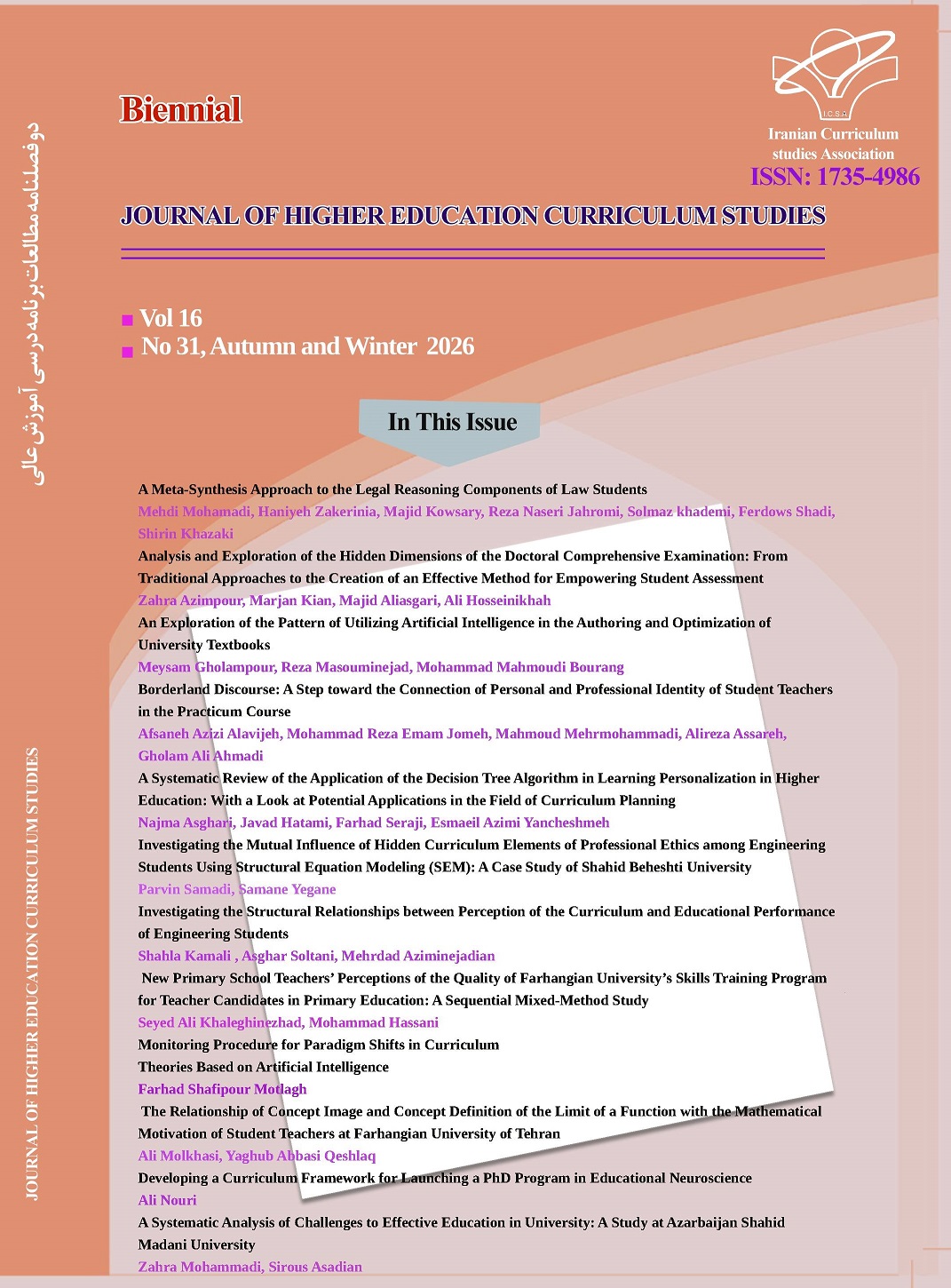
Document Type : Research Paper
Authors
1
PhD student, Department of Educational Sciences, Faculty of Humanities, Tarbiat Modares University.
2
Full Professor, Department of Educational Sciences, Faculty of Humanities, Tarbiat Modares University
3
Full Professor; Department of Educational Sciences and Psychology, University of Tehran.
4
Assistant Professor, Department of Educational Sciences, Faculty of Humanities, Tarbiat Modares University
10.22034/hecs.2025.530632.2017
Abstract
The purpose of this study was to systematically review the research conducted on the application of the decision tree algorithm in the personalization of electronic learning in higher education. Given the importance of electronic learning environments in overcoming temporal and spatial limitations and increasing educational efficiency, intelligent learning technologies for adapting education to the individual needs of students have been the subject of much research in recent years. In this article, using the PRISMA protocol, 15 scientific studies (articles and theses) out of 84 initial studies, within the time range of 2015 to 2025, were identified and analyzed. The extracted data included information related to the objectives, type of data, and the process of applying the decision tree algorithm. The analysis of this data was carried out using a comparative approach to examine different methods of implementing the algorithm in different areas of electronic learning. To evaluate the quality of the studies, a descriptive approach based on transparency and qualitative validity was used, which included examining the transparency of objectives, data collection methods, data analysis, and results. The findings showed that the decision tree algorithm has applications in areas such as predicting academic performance, personalizing learning paths, supporting educational decision-making, developing recommender systems, and optimizing learning processes. These studies, by collecting diverse data including cognitive, academic, educational, social, and interactional characteristics, have built and trained decision tree models. With a focus on the field of curriculum planning, this study shows that the decision tree algorithm, as an interpretable and powerful method in machine learning, can facilitate the personalization of students' learning paths based on individual characteristics and needs.
Keywords
Subjects